

A Resilient Economy and a Higher-for-Longer Rate Environment
Key Takeaways:
Harvest Tax Losses Where Appropriate
Rising interest rates have left some fixed income positions below purchase price, creating opportunities to realize losses that may offset gains elsewhere in a portfolio.
Reassess Duration and Credit Risk
Absolute yields remain highly attractive, but investors are receiving relatively little additional compensation for taking on longer duration, lower credit quality, or more aggressive spread-sector exposure. This may be an opportune time to evaluate whether portfolio risk levels remain aligned with long-term objectives.
Revisit Municipal Bonds
Taxable-equivalent yields (TEYs) in the municipal market are among the most compelling levels seen in years. For many investors, particularly those in retirement or approaching retirement, high-quality municipals may provide after-tax income that rivals or exceeds comparable taxable alternatives while preserving portfolio quality.
2026 began as another promising year for fixed income investors, with attractive yields across the curve and the prospect of multiple Federal Reserve (Fed) rate cuts. This narrative shifted as inflation from elevated energy prices, ongoing fiscal deficits, and stronger-than-anticipated economic activity drove markets to re-rate bond yields higher. Central banks around the world, including the Fed, maintained restrictive monetary policies while a strong labor market, consumer, and artificial intelligence tailwinds helped support economic growth and keep long-term interest rates up.
While the broader economy has remained durable, the effects of higher borrowing costs are becoming increasingly evident beneath the surface. More leveraged sectors face growing challenges, while companies with stronger balance sheets have generally been rewarded.
The result has been another reminder that fixed income investing remains highly dependent on valuation, risk management, and security selection, particularly during periods of elevated uncertainty.
For investors reviewing fixed income allocations ahead of year-end, the current market environment presents several noteworthy opportunities and considerations for 2027:
Tax-Loss Harvesting Opportunities
With interest rates moving higher over much of 2026, some portfolios and individual fixed income positions remain below their original purchase prices. While losses are far less severe than those experienced during the 2022 bond market selloff, they may nevertheless create valuable tax-planning opportunities.
Unlike 2022, equities have generally performed well this year, increasing the potential value of realized losses that can offset taxable gains elsewhere in a portfolio.
If utilizing a Separately Managed Account (SMA), a portfolio manager can selectively realize losses on individual securities while maintaining the targeted market exposure.
As always, investors should work closely with their financial and tax advisors to determine whether the potential benefits justify the associated transaction costs and portfolio adjustments.
Consider Reducing Unnecessary Risk
Many fixed income investors naturally gravitate toward highly rated and widely followed bond strategies managed by large, well-known firms. Frequently, however, these strategies are benchmarked against broad investment-grade indices that contain meaningful exposure to longer-duration securities, lower-quality investment-grade credits, mortgage-backed securities, structured products, and, in some cases, high-yield bonds.
There is nothing inherently wrong with these strategies, and we manage similar portfolios ourselves. However, many high-net-worth investors and smaller institutional accounts may not require the level of interest-rate and credit risk embedded in these benchmarks. The yields will be lower, but by moving away from the riskier parts of the market, they should be better positioned if interest rates spike or spreads suddenly widen.
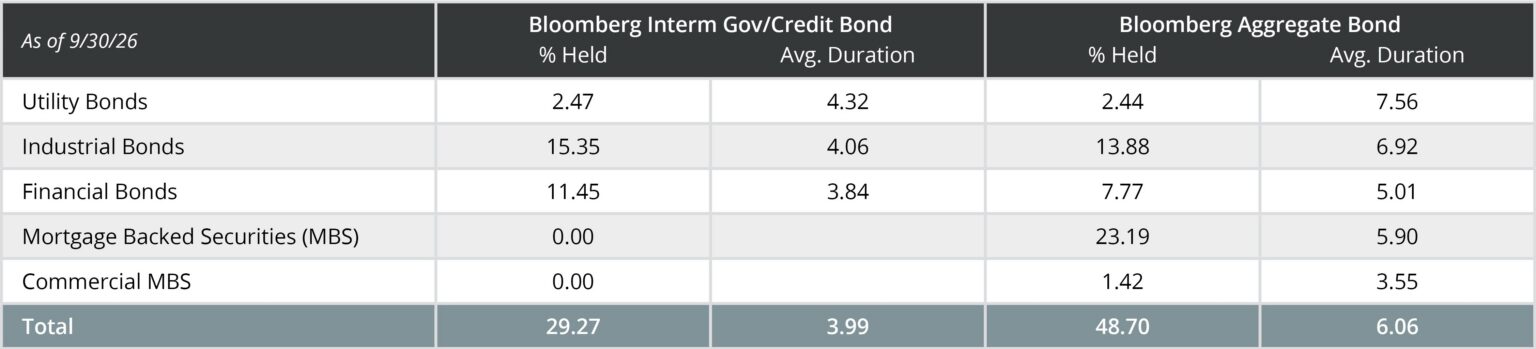
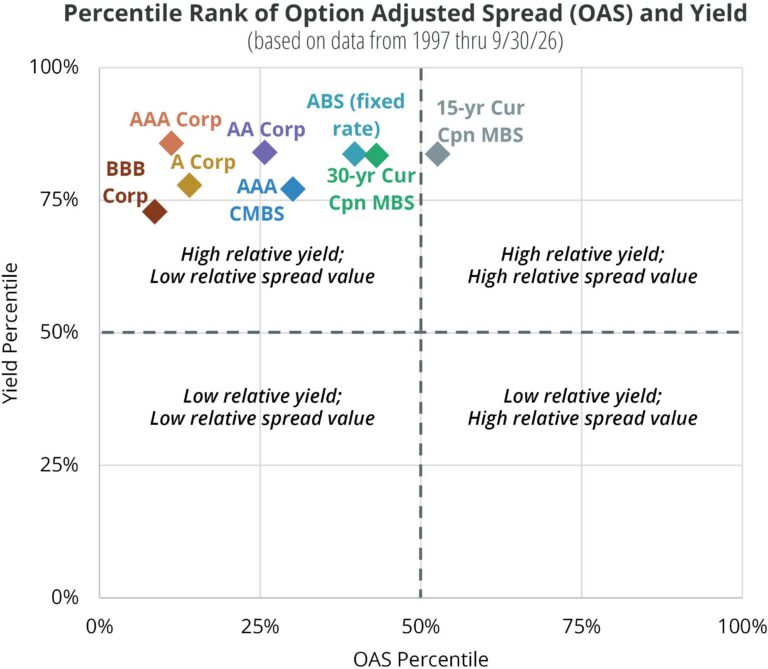
Today’s environment presents a unique opportunity. Absolute yields across many high-quality fixed income sectors remain among the most attractive levels investors have seen in more than two decades. At the same time, the incremental compensation for taking on additional spread risk remains relatively limited by historical standards.
As the chart below shows, investors are currently earning attractive absolute yields while receiving comparatively modest compensation for extending into lower-quality credit sectors. Although certain securitized sectors offer somewhat better relative value, opportunities remain selective rather than broad-based.
A Compelling Opportunity in Municipal Bonds
Municipal bonds deserve renewed attention. It has been many years since taxable-equivalent yields (TEYs) in the municipal market have been as attractive as they are today, both on an absolute basis and relative to comparable taxable alternatives. Importantly, this opportunity extends beyond investors in the highest tax brackets.
Many retirees and pre-retirees establish minimum after-tax return objectives necessary to support long-term spending needs and financial plans. For much of the past two decades, exceptionally low interest rates often forced investors to assume greater portfolio risk in pursuit of those return targets. That environment has changed significantly. Today, many municipal bonds offer taxable-equivalent yields that can compete with, and in some instances exceed, similarly rated taxable bonds. For investors subject to both federal and state income taxes, the relative advantage may be even greater.
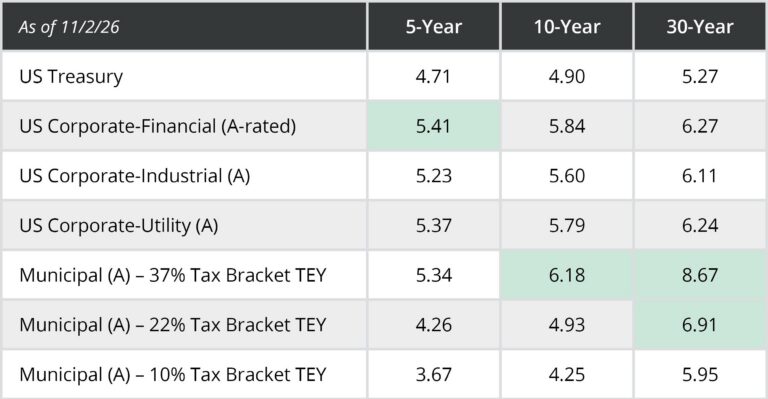
Source: Bloomberg, LSEG Municipal Market Monitor
Equally important, these elevated taxable-equivalent yields allow many investors to meet long-term return objectives while remaining focused on high-quality issuers and maintaining a disciplined risk profile.
Summary
While 2026 challenged many traditional fixed income assumptions, it also created opportunities for disciplined investors. Elevated yields, attractive municipal valuations, and the ability to selectively reduce duration and spread risk provide a favorable backdrop heading into 2027.
In our view, the most attractive opportunities are not necessarily found in taking greater risk. Rather, they are found in taking advantage of some of the highest absolute yields available in years while maintaining a disciplined focus on credit quality, diversification, and long-term portfolio objectives.